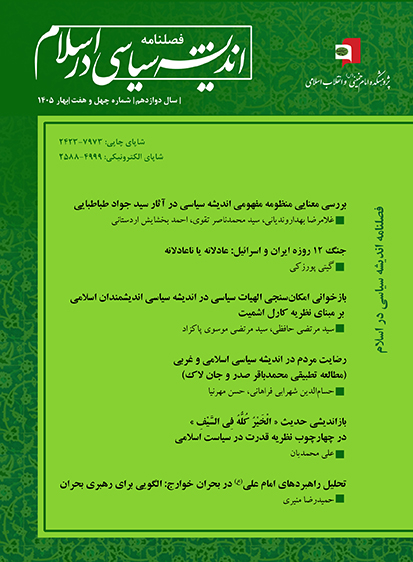
نوع مقاله : مقاله پژوهشی
عنوان مقاله English
نویسنده English
The 12-Day War between Iran and Israel is one of the most controversial contemporary military conflicts in the Middle East, provoking conflicting claims about self-defense, preemptive war, and security necessity. This article uses the framework of just war theory and focuses on its contemporary readings in the works of Michael Walzer to assess the moral and normative aspects of this war. The central question of the research is whether Israel’s military action can be interpreted as a legitimate and morally justified preemptive or preventive attack. In order to answer this question, and using Walzer’s theory, the war is assessed based on the criteria of (justice in war) and (justice during war). The findings show that, according to the criteria of Michael Walzer’s just war theory, Israel was not facing an actual or imminent armed attack or threat from Iran at the time of the operation, and therefore the “just cause” condition in the sense of legitimate defense was not met. In addition, the existence of active diplomatic channels and ongoing nuclear negotiations undermine the “last resort” condition. An analysis of the objectives and consequences of the war shows that the “reasonable probability of success” condition was also not met and the declared objectives, including the destruction of the nuclear program and the establishment of a sustainable deterrent, were unattainable, at least in the short term. At the level of justice during the war, international evidence and reports indicate widespread civilian casualties and damage to civilian infrastructure, which reinforces the violation of the principles of proportionality and distinction. In summary, the article concludes that the 12day war between Iran and Israel did not meet the necessary moral conditions from the perspective of just war theory, neither at the beginning nor during it.
کلیدواژهها English