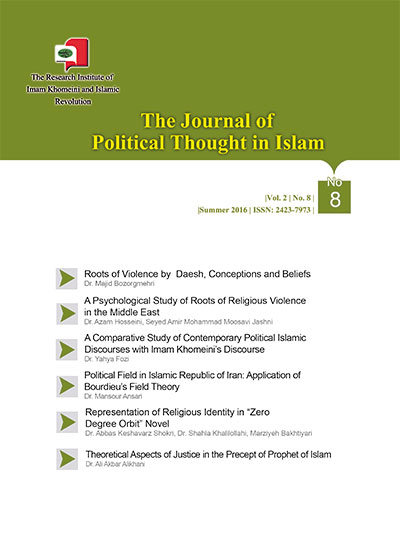
The Journal of Political Thought in Islam

The Journal of Political Thought in Islam

Publishing country: Iran

Publisher: Research Institute of Imam Khomeini and Islamic Revolution

Format: printed and online

Printed ISSN: 2538-3183

online ISSN: 2538- 3191

Accessible at: magiran.com, noormags.ir, civilica.com

Percentage of articles admitted: 49%

Printing status: printed and online

Publishing period: quarterly

Prior access: yes

Journal’s language: Persian (along with English abstract)

Field of specialty: Political Thought

Cost of paper printing: free

Free of charge access to articles: yes

Indexed:  yes

Referee type: closed refereeing with at least 2 referees

Refereeing time: at least 9 weeks

Journal’s email: andishehsiyasi@gmail.com

 free access: to get easy and global access to the latest research findings, this publishing company is established as an Open Access Journal.

copyright: this journal is under international copyright law of Creative Commons: CC BY 4.0.

Keywords Cloud

  • Imam Khomeini
  • Islamic Revolution
  • Political Thought
  • Politics
  • Violence
  • Peace
  • Political Islam
  • Democracy
  • Imam Khomeini (RA)
  • Islamic Republic
  • Islamic Republic of Iran
  • Government
  • Social Justice
  • Islamic Revolution of Iran
  • Women
  • Islam
  • freedom
  • Identity
  • Islam
  • Islamic Civilization
  • Salafism
  • Ayatollah Khamenei
  • political philosophy
  • Wahhabism
  • Sayyid Qutb
  • \"
  • modernity
  • the West
  • : Imam Khomeini
  • People
  • Discourse
  • Iran
  • West
  • Caliphate
  • world of Islam
  • war
  • political mysticism
  • Political Justice
  • Extremism
  • Reformist Discourse
  • Progress
  • ethical governance
  • religion
  • consensus
  • Middle East
  • Religious Democracy
  • political participation
  • Justice
  • Anthropology
  • Islamic Government
  • thought
  • identity
  • political system
  • Constitution
  • export of revolution
  • political jurisprudence
  • Civilization
  • new Islamic civilization
  • Unity
  • Takfir
  • Political Theology
  • Epistemology
  • Saudi Arabia
  • Iran
  • Ideal Government
  • political thought of Islam
  • Islamic Consultative Assembly
  • Shariati
  • ISIS
  • Hermeneutics
  • system-building
  • Islamic political thought
  • Islamic movements
  • ethical politics
  • Skinner
  • public interest
  • Farabi
  • Islam World
  • methodology
  • Jihad
  • Power
  • External Factors
  • International System
  • Al-Qaeda
  • Seyyed Javad Tabatabai
  • Internal Factors
  • America
  • political rationality
  • deconstruction
  • cultural diplomacy
  • positive peace
  • Hazrat Fatima (peace be upon her)
  • Rights
  • Islamic Revolution Discourse
  • Lebanon
  • Agonism
  • Fundamentalism History
  • National Consensus
  • treating people kindly
  • Value
  • divine motivation
  • Pathology
  • International System Developments
  • Sovereignty
  • Ayatollah Javadi Amoli
  • Bipolar System
  • legitimacy
  • critical discourse analysis
  • Tradition
  • secularism
  • Ali Shariati
  • Fadakiyya sermon
  • Islamic Protestantism
  • Shiite
  • Salafi Extremism
  • Non-alignment Movement
  • just war
  • committed democracy
  • Quran
  • expediency
  • Pacifism
  • Phenomenology
  • rule of jurisprudent (velayat-e faqih)
  • Velayat al-Faqih
  • equality
  • political value
  • Hezbollah
  • party
  • Sufi political thought
  • purification of carnal soul
  • Traditionalism
  • Independent Islamic bloc
  • Antagonism
  • council
  • Jurisprudence
  • Representation
  • Political Mobilization
  • Cold War
  • interpretation
  • Populism
  • aims of government
  • Women’s political participation
  • Discourse Analysis
  • Fundamentalism
  • modernism
  • \"Revoloution\"
  • Appointed Supreme Leader
  • Michael Walzer
  • Antagonism\"
  • Transcendent Governance
  • Hamas
  • Muʿtazila
  • Fiqh
  • the practice of justice
  • Takfiri currents
  • Articulation
  • Salafi
  • Khomeini
  • Originality
  • Ibn Taymiyyah
  • Hybrid Democracy
  • محمدحسین تبریزی‌
  • Keywords: \"Divine Providence\"
  • ontology
  • political progress
  • freedom of women
  • theme
  • critical theory
  • Political thought in Iran
  • civilizational approach
  • power \"
  • eastern schools
  • Relative deprivation
  • Grounded theory
  • Khawarij
  • Baalbek
  • political organization
  • Piety\"
  • Ideology
  • Ayatollah Sistani
  • hijab issue
  • Liberalism
  • Practical Ethics
  • United States
  • Female Representatives
  • transcendental reason
  • cultural reason
  • elections
  • \"Politics\"
  • Karl Mannheim
  • cultural influence
  • Arab countries
  • textualist method
  • Identity Building
  • Velayat Faqih
  • ضدروشنگری
  • Salafi ijtihad
  • Egypt
  • Judiciary
  • hierarchies of peace